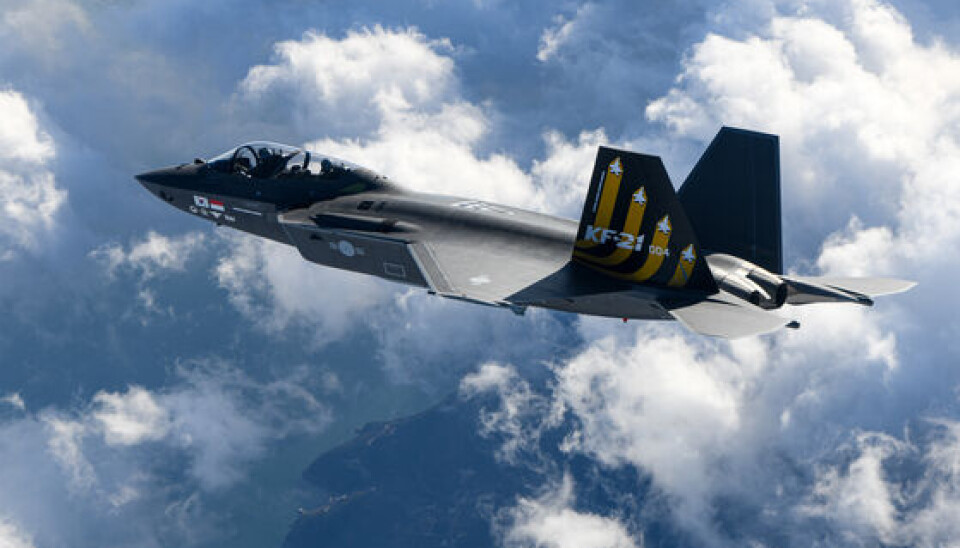
The KF-21 Boramae fighter jet flies across the sky near the Seoul Air Base in Seongnam, Gyeonggi, on Oct. 17, 2025.YONHAP
Indonesia is stepping away from a plan to build Korea's KF-21 Boramae fighter locally, an arrangement that could lead to a small order of jets.
The move came as the Southeast Asian nation weighed the costlier KF-21 commitment against its expanding purchases of French Rafale jets and scaled down the joint project it had pursued with Korea Aerospace Industries (KAI) and Seoul's Defense Acquisition Program Administration.
Indonesia's defense ministry announced the shift in late June. Spokesman Rico Ricardo Sirait confirmed it to the Jakarta Globe on June 29, and Air Marshal Yusuf Jauhari, head of Indonesia's Defense Logistics Agency, described it as a result of a "'comprehensive evaluation' designed to maximize technology mastery, economic value, and alignment with Jakarta’s evolving defense priorities," Defence Security Asia reported. Indonesia was the program's only foreign partner.
The KAI said Indonesia's original 2016 agreement to jointly develop the fighter included a nonbinding agreement on the acquisition of 48 aircraft once development was complete, but it was not a firm purchase order.
"Now that development is finished, what had been considered for acquisition is being worked out in concrete terms, and that could be direct import or local production," a KAI spokesperson said. "Nothing has been decided yet. There was no contract for a 48-jet order."
Korea and Indonesia are also reportedly negotiating an order for a shipment of about 16 standard-production KF-21s, a Block II squadron, funded partly through Korean export credit. The countries' two presidents, Lee Jae Myung and Prabowo Subianto, discussed the purchase at a summit in April.
Indonesia joined the Boramae program in 2016, agreeing to fund about 20 percent of development, then priced at 1.6 trillion won ($1.1 billion), in exchange for local assembly at PT Dirgantara Indonesia and a transfer of technology to its engineers. It suspended payments for years, forcing repeated renegotiations, and in 2024 Indonesian engineers faced allegations of attempting to remove sensitive KF-21 data.
Seoul cut Jakarta's obligation to about 600 billion won. Indonesia paid its final tranche of roughly 63.6 billion won in June. In return, it is to receive the fifth KF-21 prototype, a single-seat aircraft valued at about 350 billion won, along with 174.2 billion won for technology transfer and personnel and 75.8 billion won for development data.
Any acquisition would require a new production contract separate from the development agreement, much as KAI signed a separate mass production deal with Korea's arms procurement agency for the Air Force's 40 jets.
Korea's domestically developed fighter jet, the KF-21 Boramae, is seen during a test flight on Nov. 29, 2024.NEWS1
Whether the jets would be imported directly or partly built in Indonesia remains undecided and would depend on Jakarta's political and budget circumstances.
The Indonesian air force is studying an expansion of its Dassault Rafale fleet from 42 to as many as 66 jets. The original 42 were ordered under an $8.1 billion deal in 2022, of which six have been delivered. Indonesia has also placed an order for 48 KAAN fighters from Turkey.
The shift followed a run of program milestones in Korea. The KAI rolled out its first production KF-21 on March 25 and is scheduled to begin delivering aircraft to Korea's Air Force in September. Seoul plans to field 40 Block I jets, followed by 80 Block II aircraft by 2032. The program's follow-on production budget rose by nearly 4.2 trillion won over two years to 18.44 trillion won, according to the arms procurement agency.
A deal with Jakarta would give Seoul its first export customer for the aircraft, though without the industrial participation of the original arrangement, eliminating a selling point Korea had cited in courting other prospective buyers, including Malaysia, the Philippines and the United Arab Emirates.