E-cigarettes are now subject to Tobacco Business Act, but retailers have yet to catch up
From insufficient age verification to missing warnings, vendors have failed to fully implement changes to comply with the new regulations.
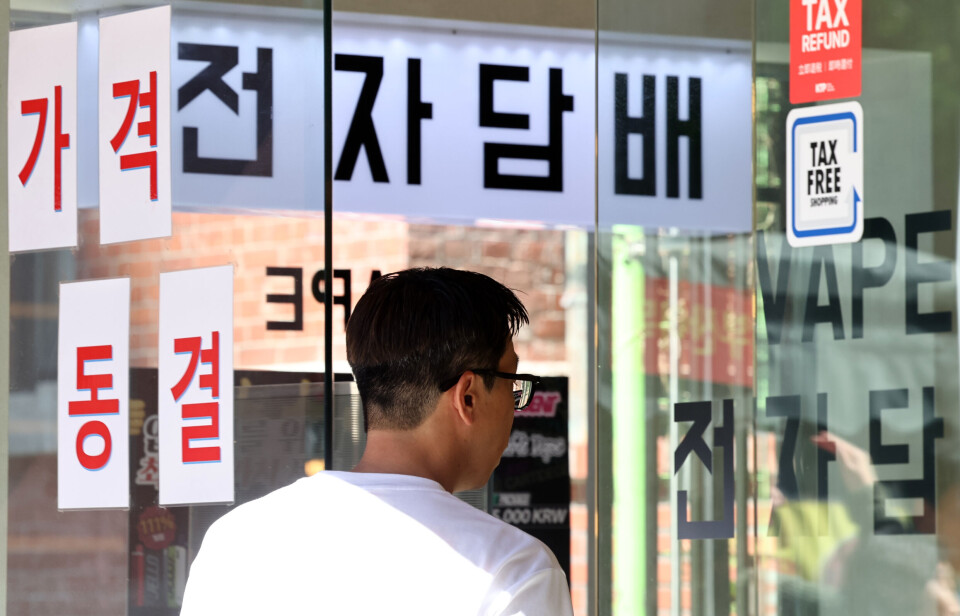
A man walks past a vape store in Seoul on June 23. The Ministry of Health and Welfare, along with local public health centers, began a nationwide inspection from June 24 to July 15 to check violations of the Tobacco Business Act, including whether tobacco vending machines have age-verification devices, after liquid-based e-cigarettes came under government oversight.
NEWS1
The Seoul Metropolitan Government said Thursday that a two-month inspection of liquid-based e-cigarette retailers found weak age-verification systems, missing warning notices and advertisements visible from outside stores, raising concerns about the enforcement of newly expanded tobacco regulations.
From April 24 to June 23, the city conducted 5,956 patrols in smoke-free areas to inform the public that liquid-based e-cigarettes are subject to the same smoking restrictions as conventional cigarettes. Officials also inspected 666 vape retailers across Seoul to check whether they were complying with rules on sales, advertising and youth protection.
Seoul found that vending machines remained a major blind spot. Of the 666 retailers inspected, 190, or 28.5 percent, operated vending machines selling liquid-based e-cigarettes or related devices.
To test the machines’ age-verification systems, Seoul officials used five fake IDs, including one resident registration card with a cartoon character's picture, two fake resident registration cards and two fake driver’s licenses.
Among 415 vending machines checked, 339 allowed age verification through resident registration cards or driver’s licenses. Of the 415 machines, 168, or 40.5 percent, accepted fake IDs. In 112 cases, machines accepted all five types of fake IDs tested by the city.
Since April, liquid-type e-cigarettes made with synthetic nicotine are subject to the same regulations as conventional tobacco products, such as cigarettes, under the Tobacco Business Act.
“It seems like minors could get their hands on e-cigarettes if they really wanted to,” said Kim Se-hwan, who lives in Eunpyeong District, northern Seoul. “E-cigarette vending machines are convenient, but they have many security flaws.”
The inspection also found poor compliance with warning requirements. Only 390 of the 666 retailers inspected, or 58.6 percent, had notices displayed inside warning that tobacco sales to minors are prohibited.
Advertisements were another concern. Of the 666 retailers inspected, 375, or 56.3 percent, displayed vape advertisements inside their stores. Among those, 254, or 67.7 percent, had advertisements visible from outside, even though tobacco advertising is allowed only inside licensed retail shops and must not be visible from outside.
“For the expanded regulations on liquid-based e-cigarettes to be effective, legal and institutional changes must be accompanied by changes on the ground,” said Cho Young-chang, the head of the city government’s Citizens' Health Bureau. “Seoul will continue various efforts, from on-site guidance to encouraging industry self-regulation, to create a smoke-free environment that puts citizens’ health first.”
For some adult users, however, the new rules are still not clearly understood.
“I didn’t know e-cigarettes weren’t allowed in smoke-free zones,” said Park Kyung-seo, a resident of Pyeongtaek in Gyeonggi. “We need to prevent minors from using them, but I’m not sure if it’s right to make it so inconvenient for adult users as well.”
BY HUR KYUNG-SEOK [[email protected]]