Samsung union seeks seat at the table for chip mega project
Samsung Electronics’ union wants labor included in talks on the company’s massive chip investments in the Jeolla region, citing worker safety, living conditions and fair compensation. Business groups are worried.
A green traffic light is seen in front of the Samsung Electronics headquarters in Gyeonggi on May 27.YONHAP
Samsung Electronics' labor union on Wednesday demanded that workers be included in discussions on the company's massive semiconductor investments planned for the southwestern Jeolla region to better protect workers’ rights and safety.
The Samsung Electronics chapter of the Samsung Group United Union, which functions as the conglomerate's cross-affiliate union, demanded the creation of a tripartite consultative body consisting of laborers, government and corporate management.
Measures to safeguard workers’ industrial safety, living conditions and compensation should be prepared alongside the investment plans, the union argued.
The union highlighted the importance of prudence and thorough preparation of what could potentially be a "project that shapes the future of the Korean semiconductor industry."
“Constructive dialogue will help turn this national project into a new leap forward for Korea,” the union said.
“Rather than haste, thorough preparation is essential. It takes at least five years to bring a single production line into operation, from selecting a site and obtaining permits to securing infrastructure such as electricity and water.”
Three sites that are reportedly being considered for chip plant in the southwestern Jeolla regionYONHAP
The union also underscored the need to attract talent and improve working conditions.
"To remain competitive, we need the determination to spare no expense in recruiting outstanding talent," it said. "That requires bold investment in securing key talent and technologies, backed by support from both the government and the company."
The union also put employee treatment on the agenda.
"We hope our members will work in places with strong industrial safety standards, quality housing and well-developed infrastructure with fair compensation," the union said. "A sound working environment and fair treatment are the surest way to retain top talent and industrial competence.”
The proposal effectively calls for formal consultations with the union throughout the planning and implementation of the investment project, business insiders say.
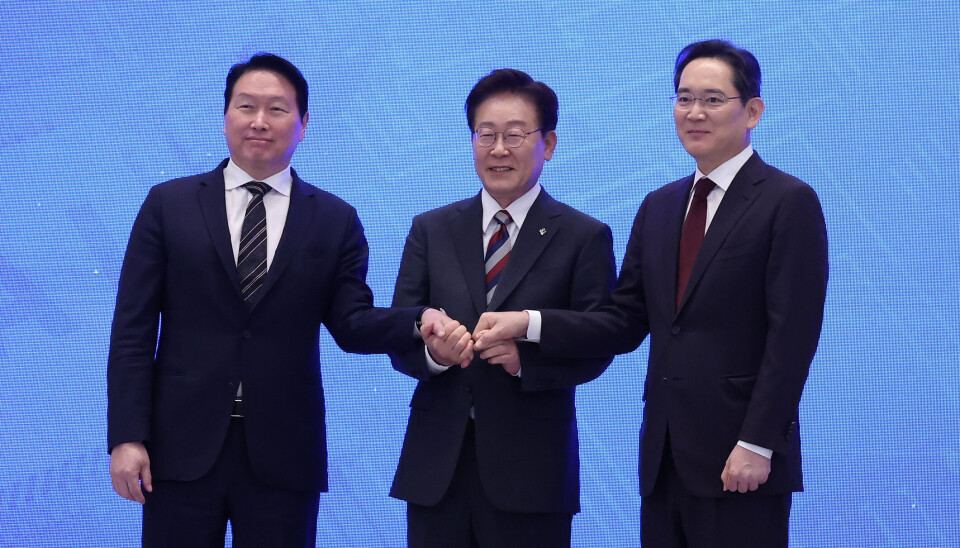
From left, SK Group Chairman Chey Tae-won, President Lee Jae Myung and Samsung Electronics Executive Chairman Lee Jae-yong join hands after announcing investments for four new chip plants in the Jeolla region at the Blue House in Jongno District, central Seoul, on June 29.JOINT PRESS CORPS
Some noted that the demands reflect the revisions to the Trade Union and Labor Relations Adjustment Act, commonly known as the "Yellow Envelope" act, which took effect this year. The amendment expanded the scope of labor disputes beyond traditional working conditions to include certain management decisions.
As a result, unions may now seek collective bargaining or industrial action if decisions to build new plants, relocate or reorganize production lines are deemed closely related to employees' working conditions.
Business groups worry that labor-management negotiations could become another key variable in large-scale semiconductor investments, alongside existing challenges such as securing electricity and water supplies and obtaining regulatory approvals.
"The union may use the project to press for a broader range of demands, including future wage negotiations and employee benefits," a business source said.
A chip cluster is being built in Yongin, Gyeonggi, on June 29.NEWS1
Samsung Electronics earlier unveiled a 2.43 quadrillion won ($1.56 trillion) chip investment plan that includes building two large semiconductor fab plants in Gwangju, expanding its Pyeongtaek Campus, developing the Yongin national industrial complex and fostering a semiconductor cluster in Gwangju.
The government pledged to support site development, permitting and the construction of essential infrastructure, including electricity and water facilities.
This article was originally written in Korean and translated by a bilingual reporter with the help of generative AI tools. It was then edited by a native English-speaking editor. All AI-assisted translations are reviewed and refined by our newsroom.