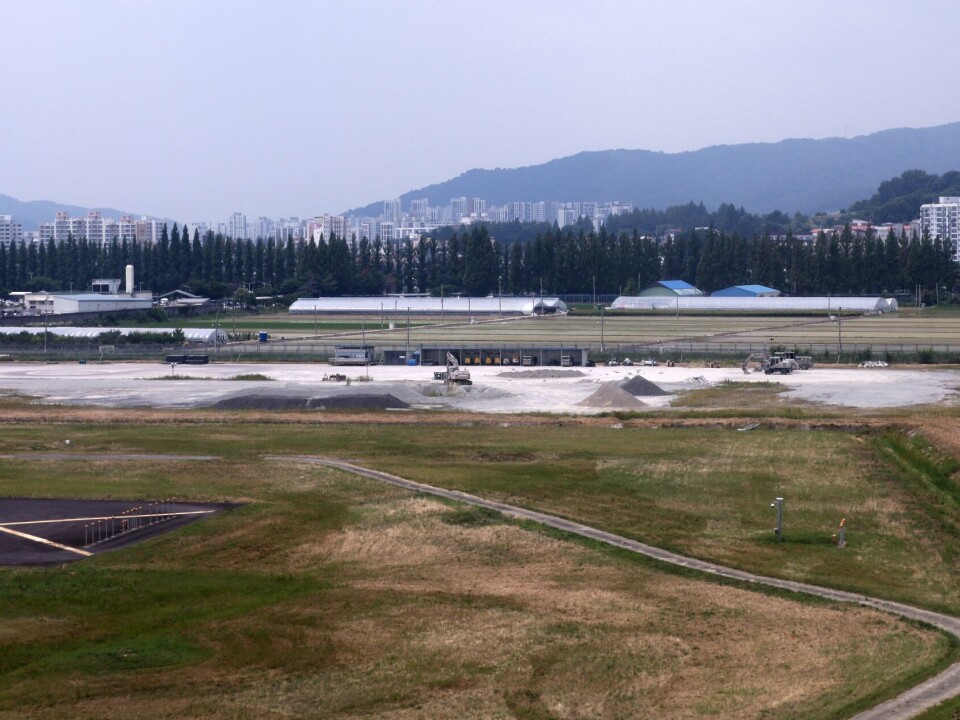
An EV participates in a vehicle-to-grid (V2G) program on Jeju Island in an undated photo.HYUNDAI MOTOR GROUP
Hyundai Motor Group will roll out a pilot vehicle-to-grid (V2G) program for retail customers in earnest, the automaker said Wednesday.
V2G technology connects EVs to the power grid, which allows the vehicles to function as small-scale energy storage systems.
Batteries are charged during off-peak nighttime hours when electricity demand is low, then discharge surplus power back to the grid during peak daytime hours to improve grid stability.
Hyundai Motor expects the trial to generate real-world V2G usage data based on the daily electricity consumption patterns of ordinary households.
The pilot will take place on Jeju Island with 40 owners of the Hyundai Ioniq 9 and its affiliate Kia’s EV9, both of which are equipped with large-capacity batteries.
If 100,000 EVs with 10-kilowatt batteries each were to discharge electricity for one hour, they could supply up to 1 gigawatt of power — enough to meet the hourly electricity needs of roughly 800,000 people, according to the Korea Electric Power Corporation.
An EV participates in vehicle-to-grid (V2G) program on Jeju Island in an undated photo.HYUNDAI MOTOR GROUP
Korea's EV fleet recently surpassed 1 million vehicles and is projected to grow to 4.2 million by 2030. If all of them participated in V2G programs, they would provide capacity equivalent to 42 large-scale 1-gigawatt power plants.
Building pumped-storage hydropower plants to provide the same amount of electricity would cost about 84 trillion won ($55.6 billion), compared with roughly 5.46 trillion won to achieve the same storage capacity through V2G infrastructure, according to industry estimates.
Commercial deployment, however, still faces regulatory hurdles.
EVs are not yet legally classified as energy resources in Korea, which leaves no formal basis to recognize them as electricity suppliers even when they are connected to the grid.
Compensation standards for vehicle owners who feed electricity back into the grid have also yet to be established.
"To commercialize V2G, we need to move beyond demonstration projects on Jeju and create conditions that will allow the technology to expand nationwide," an industry insider said.
This article was originally written in Korean and translated by a bilingual reporter with the help of generative AI tools. It was then edited by a native English-speaking editor. All AI-assisted translations are reviewed and refined by our newsroom.